
It is nearly impossible to explain all the nuances of daily life with Crohn’s or any other chronic illness. You wake up thinking that maybe this is the day you finally feel like checking off some of your to do list. And, if you’re lucky, that is what happens. But, more likely, you start strong until your body decides it has had enough.
A typical day . . .
The day starts when I climb out of bed at 4:30 a.m., after lying awake for an hour. (Occasionally, I am lucky enough to sleep til 5:00 or 6:00.) I start my day exhausted. I try to get eight hours of sleep. Usually, it is only six hours.
Next, I shower, unless, it is one of the days I wake up nauseous. If that’s the case, I have a snack before I get started. I take 15 pills a day, plus two shots every two weeks to keep me going. And, sometimes, it’s still not enough.
Fighting fatigue is a constant battle. Chronic fatigue in autoimmune disease is much more than being tired. It is exhaustion past the point of being remedied with a nap. We have an energy bank and we must prioritize our withdrawals.
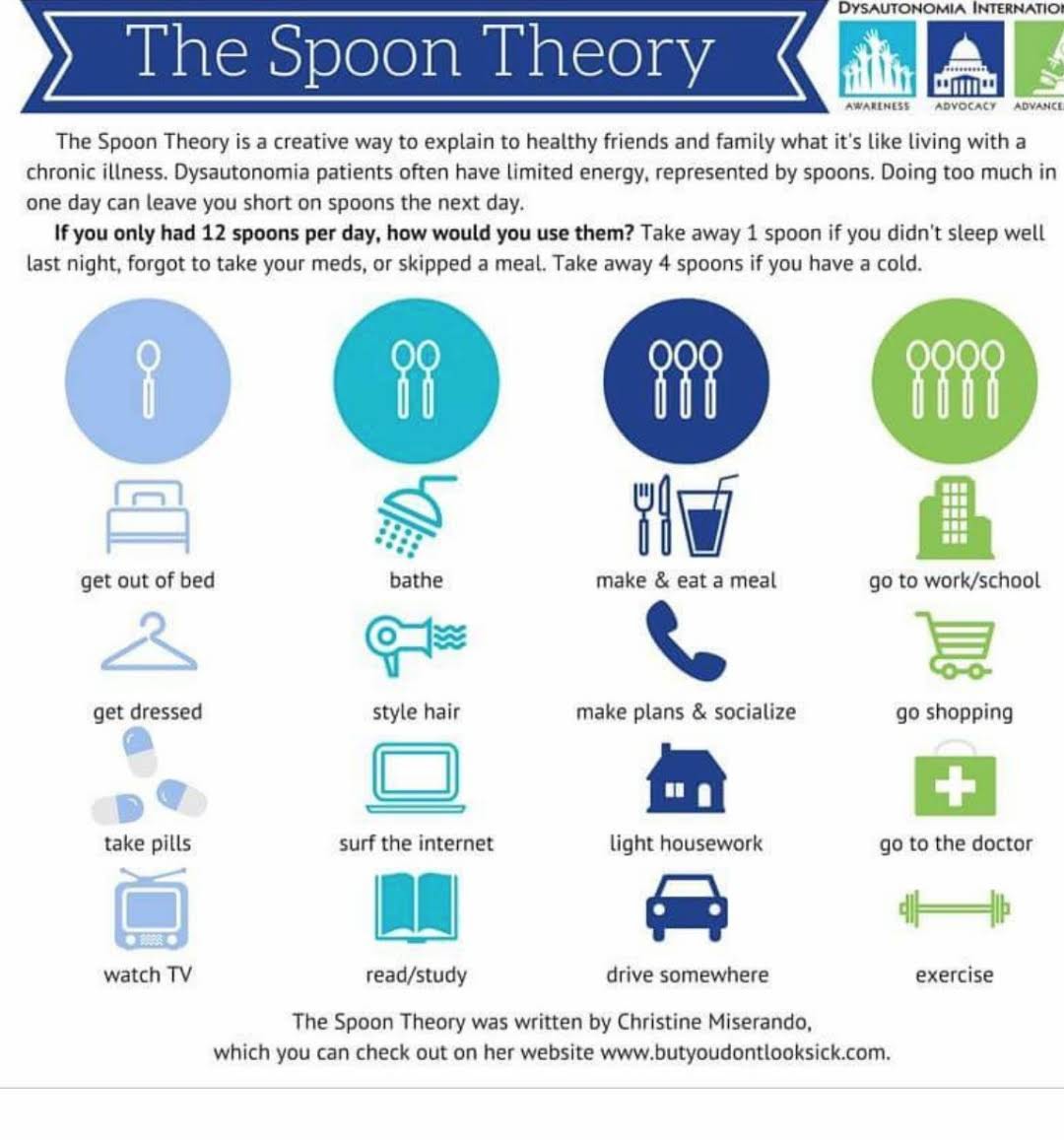
Writer Christine Miserandino developed The Spoon Theory while trying to explain to a friend what life was like living with Lupus. There is a chart that does a good job explaining The Spoon Theory. Basically, we start each day with a certain amount of energy, measured by spoons. In other words, we are allotted a number of spoons each day to spend on our daily tasks. Let’s say, we start with 12 spoons each morning. At the end of a good day, we may have spoons left over. Or, if it’s a bad day, you have a spoon deficit. Each task we do uses spoons – everything from a shower to laundry and buying groceries. Some tasks take more spoons. If you have a chronic illness, you might need more spoons than a “normal” person for the same task.
Here’s a link to The Spoon Theory written by Christine Miserandino – http://www.butyoudontlooksick.com/articles/written-by-christine/the-spoon-theory/
This is one reason people with chronic autoimmune diseases have to change plans a lot, especially at the last minute. I have always been a planner. I still am. But, I have to have a backup plan, too. I have found it is important to have a plan. Then, I can prioritize what to spend my spoons on or what activity is worth pushing through.
Reflection: Do you have a plan? A backup plan? Where will you spend your spoons, today? Know when to keep on keeping on and when to slow down and rest. And, make the most of your good days.
*** Today is a good day.
 Hidden in Plain Sight